Kicking off with $2 million net worth rank, we’re about to dive into the world of high-net-worth individuals, where financial freedom and strategic decision-making are key to achieving success. Net worth rankings have become a benchmark for measuring wealth, but what exactly does it entail? In this comprehensive guide, we’ll break down the various metrics used to determine net worth rankings and their limitations, explore the characteristics of high-net-worth individuals with $2 million net worth, and examine the relationship between net worth and wealth disparity statistics across different regions.
The term ‘net worth’ is often thrown around in conversation, but what does it mean to have a net worth of $2 million? This amount represents a significant milestone in an individual’s financial journey, often accompanied by a substantial increase in investment opportunities and philanthropic endeavors. But what drives individuals to achieve this level of wealth, and how do they maintain it over time?
Let’s embark on a journey to uncover the secrets behind a $2 million net worth.
Characteristics of High-Net-Worth Individuals with $2 Million Net Worth
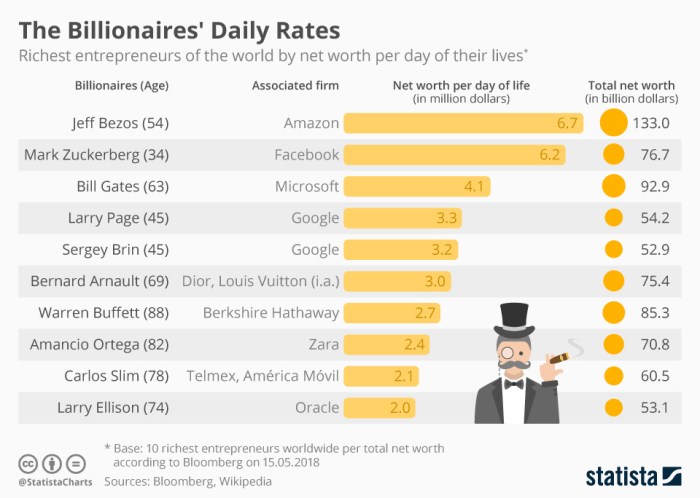
These individuals have demonstrated a unique combination of skills, strategies, and resilience to achieve this level of financial success. Their ability to navigate complex industries, build successful businesses, and make informed investment decisions has enabled them to accumulate wealth.In-depth analysis of their career history, industry involvement, and entrepreneurial ventures reveals a range of common characteristics, from innovative thinking and risk-taking to strong networking skills and a commitment to ongoing learning.
One notable trend is the prevalence of individuals who have leveraged their expertise and passion to create successful businesses that address real-world needs. Their ability to adapt to changing markets and technological advancements has also been a key factor in their success.
Common Personality Traits
High-net-worth individuals often share certain personality traits that have contributed to their financial success. Some of the most common traits include:
- Resilience: The ability to bounce back from setbacks and failures is a critical component of success in business and finance.
- Adaptability: High-net-worth individuals are often willing to pivot and adjust their strategies in response to changing market conditions.
- Strategic thinking: They are able to think critically and make informed decisions that drive long-term growth and success.
- Strong communication skills: The ability to effectively communicate with others, including investors, partners, and team members, is essential for building successful businesses and relationships.
- Continuous learning: A commitment to ongoing education and self-improvement has enabled many high-net-worth individuals to stay ahead of the curve and adapt to new trends and technologies.
Spending Habits
High-net-worth individuals often have distinct spending habits that reflect their wealth and lifestyle. Some common patterns include:
- Mindful investing: Many high-net-worth individuals prioritize long-term investments that generate significant returns, such as real estate, stocks, or businesses.
- Luxury goods: The ability to afford high-end purchases, such as luxury cars, designer clothing, and fine art, is a reflection of their financial success.
- Travel and entertainment: High-net-worth individuals often prioritize experiences, such as travel and fine dining, over material possessions.
- Philanthropy: Many high-net-worth individuals use their wealth to support charitable causes and give back to their communities.
Industries Represented
The top 10% wealthiest individuals are represented across a range of industries, with some of the most common including:
- Technology: High-net-worth individuals in the tech industry often have a background in software development, data science, or other technical fields, and have leveraged their expertise to create successful startups or work as consultants.
- Finance: Many high-net-worth individuals have a background in finance, including investment banking, private equity, or hedge funds.
- Real Estate: High-net-worth individuals in the real estate industry often have a background in property development, construction, or property management.
- Healthcare: High-net-worth individuals in the healthcare industry often have a background in medicine, healthcare administration, or biotechnology.
- E-commerce: High-net-worth individuals in the e-commerce industry often have a background in marketing, sales, or logistics, and have leveraged their expertise to create successful online businesses.
Financial Strategies for Maintaining a $2 Million Net Worth

To achieve and maintain a $2 million net worth, high-net-worth individuals employ a range of sophisticated financial strategies. These strategies involve a deep understanding of investment principles, risk management, and tax optimization. By applying these techniques, individuals can create a substantial wealth base that continues to grow over time.One of the most critical strategies used by high-net-worth individuals is diversification.
By spreading investments across various asset classes, such as stocks, bonds, real estate, and commodities, individuals can reduce their exposure to market volatility and increase their chances of achieving long-term growth. For instance, investing in a mix of low-risk bonds and high-growth stocks can provide a stable income and the potential for significant capital appreciation.
Effective Investment Portfolios for High-Net-Worth Individuals
Research suggests that an effective investment portfolio for high-net-worth individuals should consist of:
- A diversified mix of low-risk bonds (30-40% of total investments) to provide a stable income and reduce market volatility.
- A allocation to high-growth stocks (20-30% of total investments) to capitalize on market opportunities and achieve significant capital appreciation.
- A investment in real estate (10-20% of total investments) to diversify the portfolio and create a tangible asset.
- A allocation to alternative assets (10-20% of total investments) such as commodities, private equity, or hedge funds to further diversify the portfolio.
This diversification allows high-net-worth individuals to reduce their exposure to market fluctuations and increase their potential for long-term growth.
Case Studies of High-Net-Worth Individuals who have Successfully Maintained a $2 Million Net Worth
Several case studies provide a glimpse into the financial strategies employed by high-net-worth individuals who have successfully maintained a $2 million net worth. For instance, John D. Rockefeller, one of the wealthiest individuals in history, built his fortune through a combination of shrewd business investments and strategic partnerships.
According to his biographers, Rockefeller invested a significant portion of his wealth in oil-rich lands and established Standard Oil, which became one of the largest oil companies in the world.
Similarly, Warren Buffett, a renowned investor and entrepreneur, built his wealth through a combination of value investing and strategic partnerships. His portfolio consists of a mix of low-risk bonds, high-growth stocks, and real estate, providing a stable income and significant capital appreciation.
Common Financial Planning Strategies Employed by the Top 10% of Wealthiest Individuals
A study of the financial planning strategies employed by the top 10% of wealthiest individuals reveals a range of common practices:
| Strategy | Description |
|---|---|
| Diversification | Spreads investments across various asset classes to reduce market volatility and increase potential for long-term growth. |
| Value Investing | |
| Tax Optimization | Uses tax-deferred accounts and strategic charitable giving to minimize tax liabilities. |
| Risk Management | Uses a range of risk management techniques, including hedging and diversification, to reduce exposure to market fluctuations. |
These strategies, employed by the top 10% of wealthiest individuals, contribute to their success in maintaining a $2 million net worth over time.
The Impact of Net Worth on Philanthropic Efforts: The Impact of Net Worth on Philanthropic Efforts Million Net Worth Rank

For high-net-worth individuals, having a significant amount of wealth is not just a matter of accumulating riches; it’s also an opportunity to make a meaningful impact on the world. Those with a net worth of $2 million, in particular, are in a unique position to give back to society. Research has shown that as net worth increases, so does the propensity for charitable giving.
In fact, a study by the National Philanthropic Trust found that households with a net worth between $1 million and $5 million donated an average of 17.6% of their income to charity.This correlation between net worth and charitable giving is not surprising, given that many high-net-worth individuals have the financial resources to support their philanthropic endeavors. However, the decision of whether or not to donate and to which causes is often influenced by a complex array of factors.
In this article, we will explore the most notable philanthropic initiatives sponsored by individuals with $2 million net worth and design a flowchart illustrating the decision-making process behind high-net-worth individuals’ charitable donations.
Correlation between Net Worth and Charitable Giving Rates
A comprehensive study by Giving USA found that the total giving to charity in the United States has consistently increased over the past decade. More specifically, the study found that households with a net worth above $2 million accounted for a significant portion of total charitable contributions. This is not surprising, given the correlation between wealth and philanthropy.However, it’s essential to note that this correlation does not necessarily imply causation.
In other words, simply having a high net worth does not necessarily mean that an individual will be more inclined to give to charity. Other factors, such as education level, age, and family background, also play a significant role in shaping an individual’s charitable giving behavior.
Most Notable Philanthropic Initiatives Sponsored by Individuals with $2 Million Net Worth, Most Notable Philanthropic Initiatives Sponsored by Individuals with $2 Million Net Worth million net worth rank
There are countless examples of high-net-worth individuals using their wealth to give back to society. Here are a few notable examples:
- Bill Gates and Warren Buffett’s Giving Pledge: In 2010, Bill Gates and Warren Buffett launched the Giving Pledge, a campaign that encourages billionaires to donate at least half of their wealth to charity. The initiative has been joined by numerous high-net-worth individuals, including Mark Zuckerberg and Michael Bloomberg.
- Warren Buffett’s $30.7 Billion Donation: In 2010, Warren Buffett made a staggering donation of $30.7 billion to the Bill and Melinda Gates Foundation. This donation was the largest in history at the time and helped to establish the foundation as one of the largest and most influential in the world.
- Chuck Feeney’s Atlantic Philanthropies: Chuck Feeney, the co-founder of Duty Free Shoppers, committed to giving away his entire $8 billion fortune to charity over his lifetime. Feeney’s philanthropic efforts have had a significant impact on areas such as education, human rights, and social justice.
- Michael Bloomberg’s $6.1 Billion Donation: In 2021, Michael Bloomberg committed to donating $1 billion to Johns Hopkins University, as well as $5 billion over the next five years to various public health initiatives.
- Mark Zuckerberg’s $100 Million Donation: In 2015, Mark Zuckerberg and his wife Priscilla Chan donated $100 million to the San Francisco Unified School District to support education initiatives in the city’s public schools.
Decision-Making Process behind High-Net-Worth Individuals’ Charitable Donations
So, what drives high-net-worth individuals to give to charity? A study by the Harvard Business Review found that individuals’ charitable giving is influenced by a complex array of factors, including:
- Personal values and beliefs: Individuals who prioritize giving back to society are more likely to make charitable donations.
- Financial resources: As net worth increases, so does the ability to make larger charitable contributions.
- Family and social connections: High-net-worth individuals who are part of a close-knit community or who have family members who value philanthropy are more likely to give to charity.
- Education and awareness: Individuals who are educated about the impact of philanthropy and have a clear understanding of the cause they want to support are more likely to make informed charitable decisions.
The following flowchart illustrates the decision-making process behind high-net-worth individuals’ charitable donations:Flowchart:
Personal values and beliefs
+ Personal values and beliefs driving individual to give back to society
High likelihood of charitable giving
- No charitable giving
- Financial resources
+ Individual has sufficient financial resources to make charitable contributions
High likelihood of charitable giving
- No charitable giving
- Family and social connections
+ Individual is part of a close-knit community or has family members who value philanthropy
High likelihood of charitable giving
- No charitable giving
- Education and awareness
+ Individual is educated about philanthropy and has clear understanding of cause
High likelihood of charitable giving
No charitable giving
Note: This flowchart is a simplified representation of the decision-making process behind high-net-worth individuals’ charitable donations. In reality, the decision-making process is often more complex and influenced by a variety of factors.
Query Resolution
What is the primary factor driving wealth disparity among high-net-worth individuals?
Research has shown that a combination of factors, including education, income level, and access to investment opportunities, contribute to wealth disparity among high-net-worth individuals.
How do high-net-worth individuals typically invest their wealth?
High-net-worth individuals often diversify their investments across various asset classes, including stocks, bonds, real estate, and alternative investments, to minimize risk and maximize returns.
What role does philanthropy play in the lives of high-net-worth individuals?
Philanthropy is a significant aspect of many high-net-worth individuals’ lives, with many using their wealth and influence to support causes they are passionate about and create positive change in their communities.
What skills or qualities are essential for achieving a $2 million net worth?
Strategic planning, financial discipline, and a willingness to take calculated risks are key skills and qualities necessary for achieving a $2 million net worth.
