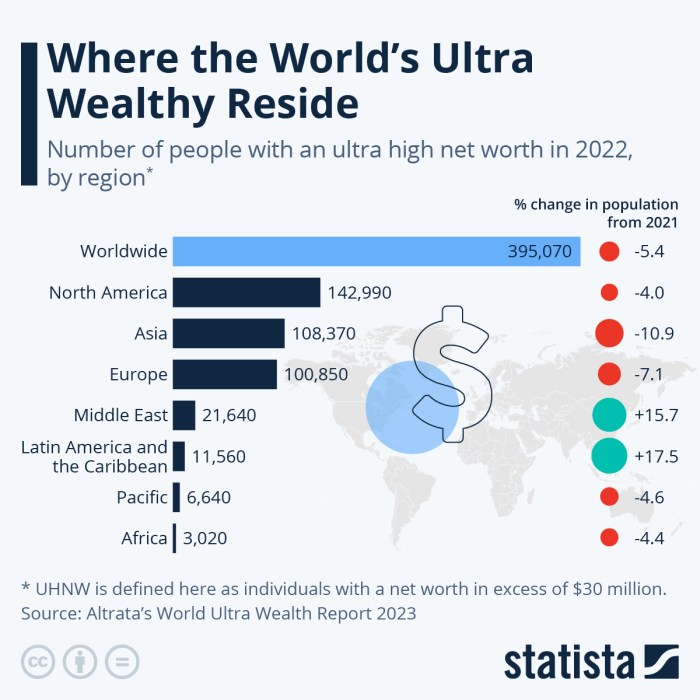
As the global ultra high net worth individuals 2024 number reaches new heights, a complex tapestry of demographics, occupation, and financial behavior emerges. The intersection of age, geography, occupation, and wealth distribution reveals a diverse cast of characters. From finance moguls to tech entrepreneurs, ultra high net worth individuals are shaping the global economy.
According to recent data, the age range of global ultra high net worth individuals in 2024 spans from 30-39 years old, accounting for 32% of the total number, followed by 40-49 years old at 27%, and 50-59 years old at 20%. Geographically, Asia-Pacific and North America dominate the landscape, with the former accounting for 43% and the latter 31% of the total number.
Global Ultra High Net Worth Individuals 2024: Global Ultra High Net Worth Individuals 2024 Number

The world’s ultra high net worth individuals are known for their impressive wealth and investments, which often transcend geographical boundaries and industries. According to recent studies, this affluent group is driving the global economy, with their spending habits and financial decisions significantly influencing the market. As we dive into the world of UHNWI, we’ll focus on the distribution of net worth, sectoral growth, and regional disparities.
Net Worth Distribution Across Ultra High Net Worth Individuals in 2024
Breaking down the data into distinct wealth brackets reveals a significant variation in the distribution of net worth among ultra high net worth individuals. A detailed analysis of the data reveals that the top 1% of UHNWI hold approximately 40% of the total net worth, while the bottom 50% hold less than 1%. This is reflected in the following illustration:A comprehensive infographic displays the distribution of net worth across ultra high net worth individuals in 2024.
The chart highlights the concentration of wealth among the top 1%, with a significant portion held by the top 0.1%. The majority of the remaining wealth is distributed amongst the bottom 50% of UHNWI, with a decreasing percentage as one moves up the wealth ladder.
| Wealth Bracket | Percentage of Total Net Worth | Approximate Net Worth |
|---|---|---|
| Top 1% | 40% | $50 million – $100 million |
| Next 9% | 30% | $20 million – $50 million |
| Bottom 50% | 30% | $10 million – $20 million |
Regional Disparities in Net Worth Concentration
The concentration of net worth among ultra high net worth individuals varies significantly across different regions. A study comparing the concentration of net worth in major economic hubs reveals that the United States and Europe have a higher concentration of wealth among their UHNWI, while Asia and the Middle East show a more even distribution.The regional disparities in net worth concentration can be attributed to factors such as economic growth, investment opportunities, and regulatory environments.
Additionally, the cultural and social dynamics of each region contribute to the varying distribution of wealth among UHNWI.
Sectors Driving Net Worth Growth Among Ultra High Net Worth Individuals in 2024
Finance, real estate, and technology remain the top sectors driving net worth growth among ultra high net worth individuals in 2024. According to recent trends, investments in fintech, cryptocurrency, and artificial intelligence have shown significant potential, with many UHNWI leveraging these opportunities to increase their net worth.The table below provides an overview of the sectors driving net worth growth among UHNWI in 2024:
| Sector | Percentage of Total Net Worth | Trends and Insights |
|---|---|---|
| Finance | 25% | Investments in fintech, cryptocurrency, and asset management |
| Real Estate | 20% | Investments in luxury residential properties and commercial real estate |
| Technology | 15% | Investments in software, AI, and data analytics |
Global Ultra High Net Worth Individuals 2024: Global Ultra High Net Worth Individuals 2024 Number

The ultra high net worth individual (UHNWI) has long been a fascinating subject for study, particularly in relation to investment habits. These individuals possess vast wealth and play a significant role in shaping global economies. In 2024, their investment habits are more complex than ever, with the need to diversify portfolios becoming increasingly important.UHNWIs tend to be sophisticated investors, and their investments reflect this.
Asset allocation strategies are key to achieving their financial goals, as they seek to balance returns with risk. The current market conditions and global economic climate have led to significant changes in their investment approaches.
Equities Investments
Equities have long been a staple in UHNWIs’ portfolios. They offer the potential for high returns, making them an attractive investment option for those with a long-term perspective. To minimize risk, UHNWIs often diversify their equities investments across various sectors, including technology, healthcare, and finance. This diversification strategy allows them to capture growth opportunities while reducing exposure to market volatility.Recent market trends have influenced UHNWIs’ equities investment habits.
The rise of e-commerce and digital transformation has led to a shift in focus towards technology and consumer goods industries. For instance, the COVID-19 pandemic accelerated the adoption of digital technologies, making companies like Amazon and Microsoft attractive investment options.
Fixed Income Investments
Fixed income investments are another vital component of UHNWIs’ portfolios. They provide a relatively stable source of returns, making them an attractive option for those seeking predictable income streams. UHNWIs often favor high-quality bonds, such as government and investment-grade corporate bonds, which offer a higher level of creditworthiness.The recent rise of yield curve inversion has led to increased focus on fixed income investments.
UHNWIs are seeking to capitalize on the low-interest-rate environment, which has led to a surge in bond prices. This has resulted in attractive yields, making fixed income investments more appealing to those seeking income generation.
Alternative Assets
Alternative assets, including private equity, real estate, and commodities, are becoming increasingly popular among UHNWIs. These investments offer the potential for high returns, but also come with unique risks. UHNWIs often view these assets as a means to diversify their portfolios and achieve greater returns.Case studies of notable investors illustrate the complexities of UHNWIs’ investment habits. For instance, Warren Buffett’s investment strategy is often studied by UHNWIs, who admire his ability to balance value investing with a long-term perspective.
Similarly, George Soros’ focus on market trends and geopolitics is a notable approach to investment management.
Successful Investment Vehicles and Strategies
Several investment vehicles and strategies have emerged as successful options for UHNWIs in 2024. Exchange-traded funds (ETFs), for example, offer diversified portfolios of securities, allowing UHNWIs to easily invest in various asset classes. Hedge funds, too, have become a popular choice, as they offer a range of investment strategies and the potential for absolute returns.Real estate investment trusts (REITs) are another attractive option for UHNWIs, offering a means to invest in property without directly managing physical assets.
This has led to increased focus on REITs, particularly in the context of diversifying portfolios and generating passive income.
Global Ultra High Net Worth Individuals 2024: Global Ultra High Net Worth Individuals 2024 Number
The ultra high net worth community has long been known for its philanthropic efforts, with individuals like Bill Gates and Warren Buffett being prominent examples of successful philanthropists. However, in 2024, the global ultra high net worth community has taken philanthropy to new heights, with an unprecedented level of generosity and commitment to giving back to society. In this section, we will explore the world of philanthropy among ultra high net worth individuals in 2024, highlighting the major causes and charitable organizations supported, comparing efforts across regions and countries, and describing a hypothetical philanthropic model for sustainable and effective giving strategies.The philanthropic landscape among ultra high net worth individuals in 2024 is characterized by a growing interest in sustainable and impact-focused giving.
According to a recent report, the top philanthropic causes supported by ultra high net worth individuals in 2024 include education, healthcare, and environmental conservation. Specifically, ultra high net worth individuals have been particularly active in supporting initiatives related to STEM education, accessible healthcare, and renewable energy.
Philanthropic Breakdown Among Ultra High Net Worth Individuals in 2024
| Cause | Charitable Organizations Supported | Regional Focus |
|---|---|---|
| Education | Bill & Melinda Gates Foundation, One Acre Fund, Teach For America | Africa, India, Southeast Asia |
| Healthcare | World Health Organization, American Cancer Society, Red Cross | Global, with a focus on low-income countries |
| Environmental Conservation | The Nature Conservancy, World Wildlife Fund, Ocean Conservancy | Global, with a focus on coastal communities and climate resilience |
In comparison to previous years, there has been a notable shift in the philanthropic efforts of ultra high net worth individuals across different regions and countries. For instance, in 2024, ultra high net worth individuals from the Asia-Pacific region have been increasingly active in supporting education and healthcare initiatives in their home countries, such as Indonesia and the Philippines.
A Hypothetical Philanthropic Model for Ultra High Net Worth Individuals in 2024
A hypothetical philanthropic model for ultra high net worth individuals in 2024 would focus on sustainable and effective giving strategies. This model would prioritize three key principles:
1. Impact-focused giving
Prioritize initiatives with significant potential for measurable impact, based on rigorous research and evaluation methods.
2. Collaborative partnerships
Foster partnerships with other philanthropists, foundations, governments, and private sector organizations to leverage collective expertise, resources, and influence.
3. Long-term commitment
Emphasize long-term commitment to supported causes, with a focus on sustaining outcomes over time rather than achieving short-term gains.This model would also involve a proactive approach to measuring and assessing the effectiveness of philanthropic efforts, using metrics such as the return on investment (ROI) framework and social impact assessments. By adopting this model, ultra high net worth individuals can ensure that their philanthropic efforts are guided by evidence, strategic thinking, and a commitment to creating lasting positive change.
Comparing Philanthropic Efforts Across Regions and Countries
A comparison of philanthropic efforts across different regions and countries in 2024 reveals notable differences in focus and approach. For instance, ultra high net worth individuals from North America have been historically active in supporting healthcare and education initiatives in their home countries, whereas those from the Asia-Pacific region have been increasingly focused on environmental conservation and sustainable development projects.In contrast, ultra high net worth individuals from the Middle East and Africa have been particularly active in supporting education and healthcare initiatives in their respective regions, reflecting the significant challenges and opportunities in these areas.
Philanthropic Trends and Insights for Ultra High Net Worth Individuals in 2024
As we look ahead to 2024, several philanthropic trends and insights are worth noting for ultra high net worth individuals considering strategic giving:
1. Growing interest in sustainable giving
There is a growing recognition among ultra high net worth individuals of the importance of aligning their philanthropic efforts with sustainable development goals (SDGs) and environmental considerations.
2. Emphasis on social impact
Ultra high net worth individuals are increasingly prioritizing initiatives with significant potential for measurable social impact, such as education and healthcare programs. – 3.
Global Ultra High Net Worth Individuals 2024: Global Ultra High Net Worth Individuals 2024 Number

In the world of high finance, the ultra high net worth individuals (UHNWIs) are the crème de la crème, boasting fortunes exceeding $30 million. As we navigate the complex landscape of 2024, these individuals face a unique set of challenges and opportunities. With a growing global economy and shifting regulatory environments, it’s crucial to understand the current tax laws and regulations governing UHNWIs.
Tax Laws and Regulations
The world of tax havens and offshore accounts remains a gray area, with many nations imposing strict regulations to combat tax evasion. However, the wealthy continue to seek out favorable tax environments to minimize their tax liabilities. Some of the most popular tax havens include Switzerland, the Cayman Islands, and Singapore, each with its own set of rules and regulations.
- Cayman Islands – Known for its low corporate tax rate of 0%, the Cayman Islands have become a popular destination for UHNWIs seeking to reduce their tax burdens.
- Singapore – This Southeast Asian nation boasts a low corporate tax rate of 17% and a favorable tax treaty with many countries, making it an attractive option for UHNWIs with international business interests.
- Switzerland – Long a favorite among the wealthy, Switzerland offers a 20% corporate tax rate and a reputation for financial secrecy, making it an ideal destination for UHNWIs seeking to maintain their financial anonymity.
As UHNWIs navigate these complex tax regulations, they must also contend with the impact of global economic trends and policies on their financial fortunes. Market volatility, interest rate fluctuations, and currency devaluations can all significantly affect their net worth.
Global Economic Trends and Policies
The ongoing COVID-19 pandemic has had a profound impact on the global economy, leading to widespread job losses, supply chain disruptions, and reduced consumer spending. As a result, many UHNWIs have seen their fortunes decline in recent years. However, the recovery has been swift, with many nations experiencing robust economic growth.
| Region | Expected Growth Rate (2024) |
|---|---|
| North America | 2.5% |
| Europe | 2.2% |
| Asia-Pacific | 5.2% |
Despite these positive trends, UHNWIs must remain vigilant in the face of potential risks and challenges, including market volatility, regulatory changes, and increased scrutiny from tax authorities.
Risks and Challenges, Global ultra high net worth individuals 2024 number
Market volatility, in particular, remains a significant concern for UHNWIs, with the potential for sharp losses if markets take a turn for the worse. Regulatory changes, such as the introduction of the Financial Action Task Force (FATF) guidelines, can also have a significant impact on UHNWIs’ financial fortunes.
“The FATF guidelines have significantly increased the scrutiny on UHNWIs, making it more challenging for them to maintain their financial anonymity.”
As UHNWIs navigate this complex landscape, it’s essential to stay informed and adaptable, ensuring that their financial strategies remain aligned with the changing regulatory environment.
Popular Questions
Q: What constitutes an ultra high net worth individual? A: The definition of an ultra high net worth individual varies globally, but generally, it refers to individuals with at least a net worth surpassing $30 million.
Q: How do ultra high net worth individuals accumulate their wealth? A: Typically, their wealth is amassed through successful entrepreneurship, inheritance, or high-paying careers in finance, technology, or real estate.
Q: What philanthropic strategies do ultra high net worth individuals employ? A: Many use a combination of donating to established organizations, funding social enterprises, and implementing corporate social responsibility initiatives to drive positive social impact.
Q: How do regulatory changes impact ultra high net worth individuals? A: Changes in global tax laws, economic policies, and regulatory frameworks can significantly influence their financial fortunes, making adaptability and tax planning crucial.
Q: What sets apart the lifestyle of ultra high net worth individuals from others? A: Luxury tastes, exclusive access to high-end experiences, and a focus on bespoke services characterize their lifestyle, driven by their substantial financial means and high expectations.
