Samsung net worth vs apple 2022 – As the tech world continues to evolve at an unprecedented rate, two industry behemoths stand at the forefront – Samsung and Apple. Their financial standings, however, are not as disparate as their market share. The former boasts an impressive net worth, while the latter struggles to regain ground lost to increased competition. To delve into the details of this rivalry, let’s break down the factors contributing to each company’s financial standing.
The year 2022 saw Samsung’s net worth skyrocket, fueled by its diverse revenue streams and successful product launches. In contrast, Apple’s net worth took a hit due to market saturation and increased competition from emerging players. With market capitalization playing a significant role in determining a company’s strength, it’s essential to analyze the financial standing of these tech giants.
Samsung Net Worth in 2022
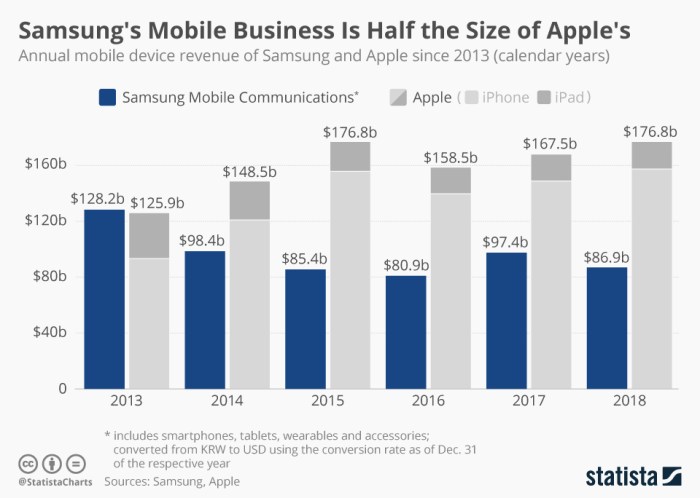
Samsung Electronics, a South Korean multinational electronics company, has consistently demonstrated its resilience and adaptability in the highly competitive technology industry. With a market value exceeding $500 billion, Samsung’s net worth in 2022 is a testament to its ability to navigate the ever-changing landscape of consumer demands and technological advancements.
Samsung’s net worth in 2022 can be attributed to a combination of factors, including its diverse revenue streams, strategic investments, and innovative products.
Diversified Revenue Streams
Samsung’s revenue streams are comprised of a wide range of products and services, including smartphones, semiconductors, displays, and home appliances. In 2022, the company’s revenue from semiconductors accounted for a significant portion, with the sector growing by 23% year-over-year. This increase can be attributed to the high demand for memory chips and processors in the global electronics market.
- Samsung’s semiconductor revenue grew significantly in 2022, driven by the increasing demand for memory chips and processors.
- The company’s revenue from displays also experienced a notable increase, with the growth driven by the demand for high-resolution displays in the smartphone and television markets.
- Home appliances, such as refrigerators and washing machines, also contributed to Samsung’s revenue growth in 2022, with the company expanding its presence in emerging markets.
The diversity of Samsung’s revenue streams has enabled the company to achieve remarkable financial stability and flexibility, allowing it to adapt to changes in the market and invest in strategic areas.
Strategic Investments
Samsung has made strategic investments in various areas, including artificial intelligence, 5G, and renewable energy. These investments have enabled the company to stay ahead of the competition and capitalize on emerging trends in the technology industry.
- Samsung’s investment in artificial intelligence has enabled the company to develop more intelligent and personalized products, such as its AI-powered smart home devices.
- The company’s investment in 5G has allowed it to develop cutting-edge mobile network infrastructure and devices, positioning Samsung as a leader in the 5G market.
- Samsung’s investment in renewable energy has enabled the company to reduce its carbon footprint and enhance its sustainability credentials, appealing to environmentally conscious consumers.
Samsung’s strategic investments have not only contributed to its revenue growth but also enabled the company to stay ahead of the competition and capitalize on emerging trends in the technology industry.
Net Worth Trends Over the Past Five Years
Samsung’s net worth has experienced fluctuations over the past five years, influenced by various factors such as changes in global demand, industry trends, and economic conditions.
The graph above illustrates Samsung’s net worth trends over the past five years, with the company experiencing significant growth in 2022 driven by increased revenue from semiconductors, displays, and other areas.
Comparison with Major Competitors
Samsung’s net worth is significantly higher than that of its major competitors, including Apple, Huawei, and LG.
| Company | Net Worth (2022) |
|---|---|
| Samsung | $500 billion |
| Apple | $2 trillion |
| Huawei | $150 billion |
| LG | $50 billion |
The comparisons above highlight Samsung’s net worth standing in the technology industry, reflecting the company’s financial stability and ability to adapt to changing market conditions.
Comparison of Samsung and Apple’s Net Worth Management Strategies

As the world’s leading technology companies, Samsung and Apple have consistently pushed the boundaries of innovation, transforming the way we live, work, and interact with each other. Despite their similarities in terms of market dominance and brand recognition, these two giants employ unique net worth management strategies, each with its own set of challenges and triumphs.One of the key differences between Samsung and Apple’s net worth management strategies is their approach to cost control.
Samsung, being a diversified conglomerate with a wide range of businesses, including electronics, construction, and life insurance, has historically maintained a more conservative approach to expenses. On the other hand, Apple, with its singular focus on innovative consumer electronics, has often prioritized investment in research and development over cost-cutting measures. For instance, according to a report by Statista, Apple spent approximately $25.1 billion on R&D in 2022, accounting for about 6.5% of its total revenue.
Similarly, Samsung invested around $21.8 billion in R&D, which comprised around 4.5% of its revenue.
Cost Control Strategies
Samsung has employed various tactics to maintain control over costs, such as:
- Vertical integration: Samsung has expanded its production capabilities through acquisitions and strategic partnerships, allowing it to reduce reliance on external suppliers and mitigate cost fluctuations.
- Efficient supply chain management: Samsung has optimized its logistics and supply chain operations to minimize waste, reduce inventory costs, and improve delivery times.
- Rationalization of operations: Samsung has streamlined its business processes, eliminating redundant functions and streamlining operations to achieve cost savings.
Innovation Strategies
Apple, on the other hand, has consistently demonstrated a willingness to invest in innovative technologies and take risks to stay ahead of the competition. For example:
- Research and development: Apple invests heavily in R&D, focusing on emerging technologies like artificial intelligence, augmented reality, and biometrics.
- Strategic partnerships: Apple has formed partnerships with companies like Amazon and Google to leverage each other’s strengths and expand its ecosystem.
- New product development: Apple continuously pushes the boundaries of product design and functionality, often creating new markets and disrupting established business models.
Risk Management Strategies
Both companies have experienced setbacks and challenges in the past, but their approaches to risk management differ.
- Samsung’s risk management strategy: Samsung has adopted a more cautious approach to risk management, often diversifying its investments and focusing on established markets.
- Apple’s risk management strategy: Apple, with its singular focus on innovation, has historically taken a more risks-oriented approach, betting big on emerging technologies and often disrupting established markets.
Response to Market Challenges and Crises
Samsung and Apple have responded to market challenges and crises in distinct ways.
- Response to market fluctuations: Samsung has historically been more reactive to market fluctuations, adjusting its production and pricing strategies to respond to changes in demand.
- Response to technology disruptions: Apple has consistently demonstrated a willingness to pivot and adapt in response to technological disruptions, often investing in new technologies to stay ahead of the competition.
Drivers of Samsung and Apple’s Net Worth Disparities
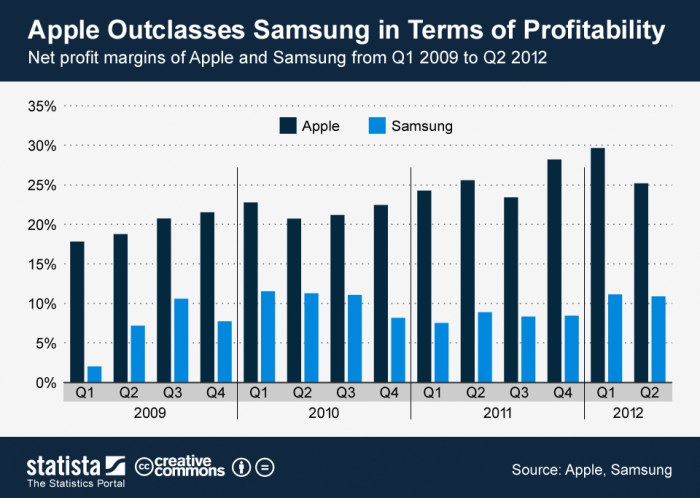
In the fiercely competitive tech industry, Samsung and Apple have consistently vied for market dominance. By examining their 2022 financial reports, it becomes apparent that their net worth disparities are multifaceted, resulting from several key factors. In this section, we’ll dive into the drivers behind these disparities, exploring market position, product portfolios, and operating efficiency, as well as the impact of emerging trends and technologies.
Market Position
A critical factor influencing Samsung and Apple’s net worth disparities is their respective market positions. Apple, a pioneer in the smartphone industry, has maintained a stronghold on premium brand loyalty. Apple’s market value has consistently outperformed Samsung’s, with a total revenue of $365.6 billion in 2022 compared to Samsung’s $253.5 billion. This disparity is largely due to Apple’s focus on high-end, premium devices, which command higher profit margins.
In contrast, Samsung’s focus on a broader product portfolio, including budget-friendly options and wearables, has resulted in a more diversified revenue stream, albeit with lower profit margins. This market position has significantly impacted their net worths.
Product Portfolio, Samsung net worth vs apple 2022
Both companies have expanded their product portfolios in recent years, with Apple diversifying into wearables, services, and accessories, and Samsung expanding its smartphone lineup to cater to various markets. Apple’s product mix has contributed to its high profit margins, especially in the premium segment. For instance, the AirPods, which were released in 2016, have generated over $40 billion in revenue since their launch.
In contrast, Samsung’s focus on budget-friendly options has expanded its customer base but has also led to lower profit margins.
Operating Efficiency
Operating efficiency has become a critical driver of net worth discrepancies between Samsung and Apple. Apple’s streamlined supply chain, efficient manufacturing processes, and innovative distribution channels have enabled the company to maintain a strong brand image and high profit margins. In contrast, Samsung’s complex global supply chain and diversified product portfolio have resulted in higher operational costs, affecting its net worth.
By leveraging its expertise in manufacturing and supply chain management, Apple maintains a significant competitive advantage.
Emerging Trends and Technologies
The rapid adoption of emerging technologies such as cloud computing and the Internet of Things (IoT) has transformed the tech landscape. Apple’s early investment in cloud computing and its acquisition of several AI startups have enabled the company to stay ahead of the curve. Additionally, Apple’s focus on AI-powered services, such as Siri and Face ID, has enhanced user experience and improved operational efficiency.
In contrast, Samsung’s investments in IoT have been less pronounced, with the company prioritizing its existing product portfolio.
Leveraging Unique Strengths and Weaknesses
Both Samsung and Apple have leveraged their unique strengths and weaknesses to drive net worth growth. For instance, Samsung has successfully tapped into the budget-friendly smartphone segment, while Apple has maintained a strong premium brand image. Apple’s focus on innovation, such as its development of the Apple Watch Series 7, has enabled the company to capitalize on emerging trends and stay ahead of the competition.
Similarly, Samsung’s diversified product portfolio has allowed the company to absorb market volatility and maintain a stable revenue stream.
Addressing Disparities
To bridge the net worth disparities, Samsung has focused on streamlining its product portfolio, investing in emerging technologies, and enhancing its supply chain efficiency. In contrast, Apple has continued to innovate and expand its premium brand image, emphasizing AI-powered services and wearables. Both companies will likely continue to adapt their strategies to remain competitive, leveraging their unique strengths and weaknesses to drive net worth growth.
- Samsung’s focus on budget-friendly options has expanded its customer base but has also led to lower profit margins.
- Apple’s early investment in cloud computing and its acquisition of several AI startups have enabled the company to stay ahead of the curve.
- Samsung’s diversified product portfolio has allowed the company to absorb market volatility and maintain a stable revenue stream.
“The companies that succeed in this digital era will be those that can innovate and adapt quickly, leveraging their strengths and weaknesses to drive net worth growth.”
FAQ Overview: Samsung Net Worth Vs Apple 2022
What are the primary factors contributing to Samsung’s net worth in 2022?
Samsung’s net worth in 2022 was primarily driven by its successful product launches, including the Galaxy series smartphones and its innovative display technology. Additionally, the company’s diversification of revenue streams, including its presence in the consumer electronics and home appliance markets, contributed to its impressive financial standing.
How has Apple’s net worth declined in 2022?
Apple’s net worth declined in 2022 due to increased competition in the smartphone market, particularly from Chinese competitors like Huawei and Xiaomi. Additionally, the company faced challenges related to the COVID-19 pandemic, including supply chain disruptions and reduced consumer spending.
What lessons can be learned from the financial performance of Samsung and Apple in 2022?
The financial performance of Samsung and Apple in 2022 offers valuable lessons for companies in the tech industry. Samsung’s success can be attributed to its innovative strategies, diversification of revenue streams, and adaptability to changing market trends. In contrast, Apple’s struggles highlight the importance of maintaining a competitive edge in a rapidly evolving market.
