Net value meaning – Imagine you’re a savvy investor navigating the world of finance, with a keen eye for opportunity and a firm grasp on risk. You’re constantly evaluating your assets, scrutinizing every transaction, and recalibrating your strategy to stay ahead of the game. This is the world of net value, where the worth of your investments is not just measured by their face value, but by their net value – the difference between what you’ve got and what you owe.
In this realm, the key to success lies in understanding the intricate dance between assets and liabilities, and how it impacts your bottom line. Whether you’re an individual investor or a corporate giant, net value is the ultimate metric for measuring financial health and making informed decisions.
At its core, net value represents the total worth of your assets minus the total value of your liabilities. But it’s more than just a simple equation – it’s a comprehensive snapshot of your financial situation, revealing the underlying strengths and weaknesses of your portfolio. By grasping the concept of net value, you’ll be empowered to make data-driven decisions, avoid costly mistakes, and unlock the full potential of your investments.
Net Value as a Concept in Economics and Management: Net Value Meaning

In the realm of economics and management, net value has been a pivotal concept that has evolved over time, influenced by various philosophical frameworks and economic theories. The concept of net value has its roots in ancient economic thought, where philosophers such as Aristotle and Adam Smith emphasized the importance of economic value as a means of understanding wealth and prosperity.
The concept of net value gained significant momentum during the Industrial Revolution, when manufacturers and entrepreneurs began to prioritize efficiency and productivity. This led to the development of cost accounting and budgeting techniques, which aimed to minimize waste and maximize profit. As the Industrial Revolution progressed, economists such as Alfred Marshall and John Maynard Keynes further refined the concept of net value, emphasizing its importance in understanding economic growth and stability.
The Historical Development of Net Value
Throughout history, net value has been shaped by various economic theories and philosophical frameworks. One of the earliest recorded references to net value can be found in Aristotle’s work “Politics,” where he emphasizes the importance of value as a means of understanding wealth and prosperity. In the 18th century, Adam Smith’s “The Wealth of Nations” further developed the concept of net value, arguing that economic value is determined by supply and demand.
During the Industrial Revolution, the concept of net value became increasingly important, as manufacturers and entrepreneurs sought to optimize production and minimize waste. This led to the development of cost accounting and budgeting techniques, which aimed to maximize profit and minimize costs. As economists such as Alfred Marshall and John Maynard Keynes continued to build upon earlier frameworks, the concept of net value became an integral part of economic theory.
Key Differences between Net Value and Gross Value
| Concept | Description | Key Characteristics | Examples |
|---|---|---|---|
| Net Value | The value of a good or service after deducting all costs, expenses, and taxes. | Minimizes waste; maximizes profit; takes into account costs and expenses. | A company’s net profit after deducting production costs and taxes. |
| Gross Value | The total value of a good or service, including all costs, expenses, and taxes. | Includes all costs and expenses; may not necessarily maximize profit. | A company’s gross revenue from sales, including all production costs and taxes. |
Resource Allocation Decisions, Net value meaning
Managers use net value to make informed resource allocation decisions, taking into account costs, expenses, and other economic factors. The process involves three key steps:
1.
- Cost analysis
Managers must identify and analyze all costs associated with a particular resource or project, including fixed and variable costs.
- Value assessment:
Managers must assess the value of the resource or project, taking into account market demand and potential revenue streams.
- Net value calculation:
Managers must calculate the net value of the resource or project, including all costs and expenses, to determine whether it is worth investing in.
Comparison with other Economic Concepts
| Concept | Description | Key Characteristics | Examples | Net Value |
|---|---|---|---|---|
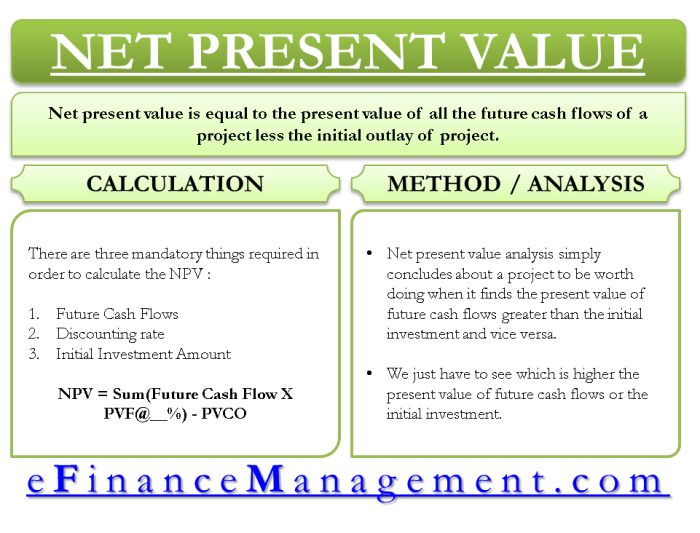
| Net Present Value (NPV) | A measure of the present value of expected future cash flows. | Accounts for time value of money; considers future cash flows. | A project’s NPV, taking into account expected future cash flows. | Similar to net value, but considers time value of money. |
| Internal Rate of Return (IRR) | A measure of the return on investment, expressed as a percentage. | Accounts for time value of money; considers returns on investment. | A project’s IRR, based on expected returns and cash flows. | Similar to net value, but considers returns on investment. |
The concept of net value has come a long way, from ancient philosophical frameworks to modern economic theories. As economic systems continue to evolve, the importance of net value will remain a crucial aspect of informed decision-making.
Applications of Net Value in Everyday Life
In the dynamic world of economics and personal finance, understanding net value is crucial for making informed decisions about one’s financial well-being. The concept of net value encompasses the value of assets minus liabilities, providing individuals and businesses with a clear picture of their financial standing. By regularly tracking and managing net value, individuals can achieve long-term financial stability and peace of mind.Net value has far-reaching applications in various aspects of everyday life, including personal finance, entrepreneurship, and investing.
Its importance lies in helping individuals and businesses make informed decisions about their financial resources, allocate resources effectively, and adapt to changing market conditions.
Applications in Personal Finance
In personal finance, understanding net value is essential for managing debt, building wealth, and achieving long-term financial goals. Here are some key applications:
- Managing debt: By calculating net value, individuals can prioritize debts to pay off high-interest loans first, minimizing the impact of interest on their financial situation.
- Building wealth: A positive net value indicates a stable financial foundation, supporting long-term wealth creation and investment opportunities.
- Investing: Regularly tracking net value helps individuals make informed investment decisions, ensuring that they allocate resources effectively across different asset classes.
- Retirement planning: A well-managed net value supports retirement goals by providing a cushion against market volatility and other financial risks.
Applications in Entrepreneurship and Investing
In entrepreneurship and investing, net value plays a critical role in evaluating business opportunities, assessing risk, and making informed investment decisions:
- Business valuation: Net value helps entrepreneurs evaluate the worth of their business, making informed decisions about funding, expansion, or divestment.
- Risk assessment: By calculating net value, entrepreneurs can identify areas of vulnerability in their business and develop strategies to mitigate risk.
- Investment evaluation: Regularly tracking net value helps investors assess the financial health of a company, making informed decisions about investments and divestments.
- Portfolio management: Managing net value is essential for maintaining a balanced investment portfolio, ensuring that individuals can adapt to changing market conditions.
Maintaining a Positive Net Value Balance
To achieve long-term financial stability and peace of mind, individuals and businesses must regularly track and manage their net value. Here are five actionable tips and strategies:
1. Establish a financial tracking system: Regularly update a spreadsheet or use financial management software to track net value.
2. Set clear financial goals: Define specific, measurable, achievable, relevant, and time-bound (SMART) goals for managing net value.
3. Prioritize debt repayment: Focus on paying off high-interest loans and credit cards first.
4. Build an emergency fund: Allocate 3-6 months’ worth of expenses for emergencies and unexpected events.
5. Diversify investments: Spread investments across different asset classes to minimize risk and maximize returns.
Illustration of a Hypothetical Scenario
Consider an individual who invests $10,000 in a taxable brokerage account and earns an average annual return of 7%. By tracking net value regularly, this individual can:* Calculate the growth of their investment over time.
- Identify areas of vulnerability, such as high-interest debt or inadequate emergency funds.
- Make informed decisions about investment allocation and risk management.
- Adapt to changing market conditions, ensuring that their net value remains stable and aligned with their financial goals.
Net Value as a Tool for Business Growth and Innovation
:max_bytes(150000):strip_icc()/NPV-final-509066b4f3734259a55f52281d155c0b.png?w=700 "Net Present Value NPV What It Means And Steps To Calculate It ...")
In today’s fast-paced business environment, companies are constantly seeking ways to differentiate themselves and stay ahead of the competition. Net value has emerged as a powerful tool for driving business growth and innovation, enabling organizations to create new value streams, improve operational efficiency, and enhance customer satisfaction.By focusing on net value, businesses can shift from a traditional cost-minimization approach to a more forward-thinking approach that prioritizes growth and innovation.
This mindset change allows companies to identify new opportunities, invest in emerging technologies, and develop innovative products and services that meet the evolving needs of their customers. As a result, net value has become a key driver of business growth and innovation.
Successfully Implementing a Net Value-Driven Approach to Innovation
Consider the case of IKEA, a furniture retailer that has successfully implemented a net value-driven approach to innovation. The company’s focus on sustainability, efficiency, and customer experience has enabled it to reduce costs, improve its bottom line, and differentiate itself in a crowded market.IKEA’s net value-driven approach to innovation involves several key strategies, including:
-
Collaboration with suppliers and partners to develop new, more sustainable products and services.
-
Investment in emerging technologies, such as solar power and data analytics, to improve operational efficiency and reduce costs.
-
Development of innovative products and services that meet the evolving needs of its customers, such as flat-pack furniture and self-assembly instructions.
-
Implementation of a robust supply chain management system to ensure just-in-time delivery and minimize waste.
These strategies have enabled IKEA to create new value streams, improve its operational efficiency, and enhance customer satisfaction. As a result, the company has experienced significant growth and innovation, solidifying its position as a leader in the furniture retail market.
Informing Product Development and Marketing Strategies
Understanding net value is essential for informing product development and marketing strategies. The following table summarizes key considerations for businesses looking to leverage net value in their product development and marketing efforts:
| Key Consideration | Description | Examples |
|---|---|---|
| Customer Value Proposition | The unique benefits and value that a product or service offers to customers. | IKEA’s flat-pack furniture, which offers customers convenience and affordability. |
| Product or Service Features | The key features and attributes of a product or service that create value for customers. | America’s Got Talent, a reality TV show that features talented individuals and showcases their unique skills. |
| Target Market | The specific group of customers that a business is targeting with its products or services. | Microsoft’s Xbox console, which targets gamers who value high-performance graphics and immersive gaming experiences. |
| Competitive Advantage | The unique strengths and capabilities that a business has that set it apart from its competitors. | Apple’s seamless integration of hardware and software, which creates a unique user experience that sets it apart from competitors. |
Cultivating a Net Value Mindset
To cultivate a net value mindset, entrepreneurs and business leaders should focus on the following key strategies:
-
Prioritize growth and innovation over cost minimization.
-
Invest in emerging technologies and sustainable practices.
-
Develop innovative products and services that meet the evolving needs of customers.
-
Implement efficient supply chain management systems.
By adopting these strategies, businesses can create a net value-driven culture that drives growth, innovation, and success. This mindset change requires a willingness to take calculated risks, invest in emerging technologies, and develop new products and services that meet the evolving needs of customers. As a result, businesses can create new value streams, improve operational efficiency, and enhance customer satisfaction, ultimately driving long-term growth and success.
Popular Questions
What’s the difference between net value and gross value?
Net value represents the total worth of your assets minus the total value of your liabilities, while gross value refers to the total face value of your assets without considering liabilities.
How does net value impact my financial health?
A strong net value indicates a healthy financial situation, while a weak net value may signal financial vulnerability. Regularly tracking your net value can help you identify areas for improvement and make informed decisions.
What are some common mistakes people make when calculating net value?
Failing to account for liabilities, neglecting to value assets correctly, and overlooking inflation or market fluctuations are all common pitfalls to watch out for when calculating net value.
Can I use net value for personal finance planning?
Yes, net value can be a valuable tool for personal finance planning, helping you track your spending, save for the future, and make informed decisions about investments, debts, and expenses.
How can I maintain a positive net value balance?
Regularly review and adjust your budget, prioritize saving and debt repayment, invest wisely, and avoid overspending to maintain a positive net value balance.
