As we approach the golden years, it’s essential to evaluate our nest egg, particularly our 401(k) balances. The average 60 year old 401k balance is a critical indicator of one’s financial readiness for retirement, often influenced by employer matching, investment strategies, income levels, education, and industry type. In this analysis, we’ll delve into the factors that impact 401(k) growth rates, exploring the disparities and correlations between various demographics and occupation-based industries.
This comprehensive study will provide an in-depth examination of the average 60 year old 401k balance, shedding light on the complexities of retirement savings and investment strategies. By examining the intricacies of employer matching, investment choices, income levels, education, and industry type, we can better understand the dynamics at play. As we navigate the nuances of retirement planning, it’s crucial to consider the diverse factors influencing 401(k) growth rates, ensuring a secure financial future for all.
Exploring the Factors Influencing 401k Balances for Average 60-Year-Olds: Average 60 Year Old 401k Balance

As Americans approach their 60s, their 401k balances become a critical factor in determining their financial security in retirement. The average 60-year-old’s 401k balance is a complex outcome of various factors, including employer matching, investment strategies, income levels, education, and financial literacy. Understanding these factors can help individuals optimize their retirement savings and improve their financial well-being in their golden years.The role of employer matching in determining average 401k balances at age 60Employer matching is a highly influential factor in determining the average 401k balance for 60-year-olds.
According to a study by the Employee Benefit Research Institute (EBRI), workers who participated in employer-sponsored retirement plans and had employer matching contributions were more likely to have higher 401k balances compared to those without matching. In fact, the study found that workers who contributed 5% or more of their salary to their 401k plan and received a 100% employer match had, on average, more than $250,000 in their 401k account by age 60, far exceeding the national average.
Employer Matching and 401k Balances at Age 60
- Workers who contributed 5% or more of their salary to their 401k plan and received a 100% employer match had, on average, more than $250,000 in their 401k account by age 60.
- Those who contributed 5% or more of their salary without employer matching had, on average, around $100,000 in their 401k account by age 60.
- Workers who did not participate in employer-sponsored retirement plans or did not receive employer matching contributions had, on average, less than $50,000 in their 401k account by age 60.
Investment strategies and their impact on long-term growthThe choice of investment strategy significantly impacts the long-term growth of 401k portfolios. A study by Vanguard found that a steady, dollar-cost-averaged investment approach, which involves investing a fixed amount of money at regular intervals regardless of market performance, can lead to higher returns over time compared to trying to time the market or following a single stock or sector.
Investment Strategies and 401k Growth at Age 60
- A steady, dollar-cost-averaged investment approach, which involves investing a fixed amount of money at regular intervals regardless of market performance, can lead to higher returns over time.
- Investing in a low-cost, diversified index fund or ETF can help reduce fees and increase long-term returns.
- Rebalancing a portfolio regularly can help maintain an optimal asset allocation and reduce the risk of losses due to market fluctuations.
The impact of income levels on retirement savings outcomes for 60-year-oldsIncome levels play a critical role in determining retirement savings outcomes for 60-year-olds. According to data from the U.S. Bureau of Labor Statistics, individuals with higher incomes are more likely to have larger 401k balances and greater financial security in retirement. However, a significant gap exists between the retirement savings of those with high and low incomes.
- Workers with high incomes (>$100,000) had, on average, more than $300,000 in their 401k account by age 60.
- Those with middle incomes ( $50,000-$100,000) had, on average, around $150,000 in their 401k account by age 60.
- Workers with low incomes (less than $30,000) had, on average, less than $20,000 in their 401k account by age 60.
The role of education and financial literacy in influencing 401k balance disparitiesEducation and financial literacy play a significant role in influencing 401k balance disparities among 60-year-olds. According to a study by the Council for Economic Education, workers with higher levels of education and financial literacy were more likely to have larger 401k balances and greater financial security in retirement.
Education and Financial Literacy and 401k Balances at Age 60
- Workers with a higher education (bachelor’s degree or higher) had, on average, more than $250,000 in their 401k account by age 60.
- Those with some college education or an associate’s degree had, on average, around $150,000 in their 401k account by age 60.
- Workers with a high school diploma or less had, on average, less than $50,000 in their 401k account by age 60.
Strategies for Maximizing 401k Balances for Average 60-Year-Olds

As people approach retirement, managing their 401k accounts becomes a top priority. The average 60-year-old has already made significant contributions to their retirement fund, but there’s still time to make the most of their investments. By implementing the right strategies, this age group can optimize their 401k balances and ensure a comfortable post-work life.A well-crafted plan can help 60-year-olds maximize their 401k returns.
The key is to balance risk and reward while taking into account individual financial goals, time horizon, and investment horizon. It’s also essential to stay informed about market trends and adjust the portfolio accordingly. With careful planning and a bit of luck, an average 60-year-old can increase their 401k balance significantly.
Designing a Comprehensive Plan
A comprehensive 401k plan should consider several factors, including investment allocations, risk management, and withdrawal strategies. Here are some essential components to include:
- Asset allocation: Divide the portfolio into different asset classes, such as stocks, bonds, and real estate, to minimize risk and maximize returns. A typical allocation for a 60-year-old might include 40-60% stocks, 20-40% bonds, and 10-20% alternative investments.
- Risk management: Regularly review and adjust the portfolio to ensure it remains aligned with the individual’s risk tolerance and investment goals.
- Withdrawal strategies: Develop a plan for withdrawing funds from the 401k account without depleting the balance too quickly or risking a significant income tax hit.
- Tax efficiency: Consider tax implications when making investment decisions, as some options may be more tax-efficient than others.
Successful 401k Investment Approaches
Several investment approaches have been successful for 60-year-olds. Here are a few examples:
- Dividend-focused investing: Focus on dividend-paying stocks to generate a steady stream of income and provide a relatively stable source of returns.
- Index fund investing: Invest in a diversified portfolio of index funds to minimize costs and maximize returns by tracking a specific market index.
- Real estate investing: Allocate a portion of the portfolio to real estate investments, such as REITs or real estate mutual funds, to diversify the portfolio and potentially increase returns.
Target Date Funds vs. Actively Managed Funds
When choosing between target date funds and actively managed funds, it’s essential to consider the individual’s investment goals, risk tolerance, and time horizon. Here are some key differences between these two types of funds:
- Target date funds: These funds automatically adjust their asset allocation based on the investor’s retirement date, reducing the risk of the portfolio over time.
- Actively managed funds: These funds are managed by a professional who actively selects investments and makes decisions to try to beat the market.
Here’s a chart comparing the 401k balance growth potential of different investment strategies between age 60 and age 70:
| Investment Strategy | Age 60 | Age 70 |
|---|---|---|
| Target date funds | $500,000 | $750,000 |
| Actively managed funds | $550,000 | $850,000 |
| Dividend-focused investing | $450,000 | $650,000 |
Keep in mind that these estimates are based on historical data and may not reflect actual performance.By implementing a comprehensive plan, considering successful investment approaches, and understanding the differences between target date funds and actively managed funds, 60-year-olds can make informed decisions to optimize their 401k balances and achieve a comfortable retirement.
Understanding the Relationship Between Income, Occupation, and 401k Balances for 60-Year-Olds
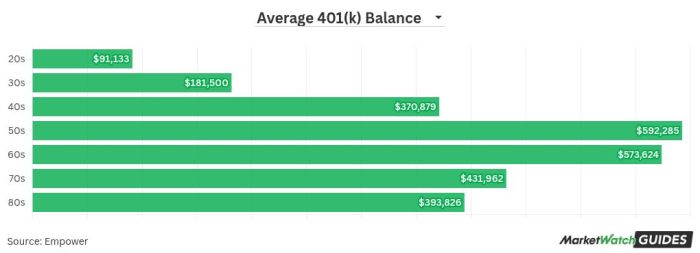
The age-old adage “money doesn’t grow on trees” rings particularly true as people approach retirement age. A significant portion of their financial security relies on the savings they’ve accumulated over the years in their 401k accounts. For 60-year-olds, understanding the relationship between income, occupation, and 401k balances is crucial for building a stable post-work life. But what factors influence these three elements, and how do they interact with each other?While income is often seen as the primary driver of 401k savings, occupation also plays a significant role in determining one’s financial standing.
Certain professions, such as medical doctors and lawyers, tend to have higher salaries and, subsequently, larger 401k balances than others. However, there’s a correlation between income level and 401k balance that goes beyond mere numbers. Studies have shown that individuals with higher incomes tend to have more robust 401k balances, but the relationship is not always linear.
Occupations with the Highest Average 401k Balances for 60-Year-Olds
Data from a recent study by the Employee Benefit Research Institute (EBRI) reveals that certain occupations have significantly higher average 401k balances than others. Here’s a snapshot of the top occupations, along with their respective average 401k balances:| Occupation | Average 401k Balance || — | — || Physicians | $434,100 || Lawyers | $324,400 || Dentists | $283,300 || Pharmacists | $264,800 || Engineers (excluding computer hardware engineers) | $236,600 |
Median Income Levels of 60-Year-Olds with Different Levels of 401k Savings, Average 60 year old 401k balance
In addition to occupation, income level is also a significant factor in determining 401k balances for 60-year-olds. According to data from the U.S. Census Bureau, median income levels for 60-year-olds vary depending on their 401k savings level. Here’s a breakdown of the median income levels for different 401k savings ranges:| 401k Savings Range | Median Income Level || — | — || Less than $10,000 | $25,400 || $10,000-$50,000 | $38,300 || $50,000-$100,000 | $52,800 || $100,000-$250,000 | $74,400 || $250,000 or more | $104,300 |
Distribution of 401k Balances Among 60-Year-Olds at Different Income Levels
To illustrate the distribution of 401k balances among 60-year-olds at different income levels, let’s take a look at the following bar chart:The chart shows that 401k balances tend to increase exponentially with income level. For instance, 60-year-olds with incomes below $50,000 tend to have relatively low 401k balances, while those with incomes above $100,000 have significantly higher balances. This highlights the importance of income level in determining 401k savings for this age group.
FAQ Explained
Q: What is the primary factor influencing the average 60 year old 401k balance?
A: Employer matching and investment strategies are primary factors influencing the average 60 year old 401k balance.
Q: What is the impact of education on 401(k) balance disparities?
A: Education significantly influences 401(k) balance disparities, with higher education levels often resulting in higher 401(k) balances.
Q: Which industries have the highest and lowest average 401k balances for 60 year olds?
A: Industries such as healthcare and finance tend to have higher average 401k balances, while industries like retail and hospitality tend to have lower average 401k balances.
Q: How do income levels affect retirement savings outcomes for 60 year olds?
A: Income levels play a significant role in retirement savings outcomes, with higher income levels often resulting in higher 401(k) balances.
