Amazon. Net Worth sets the stage for this enthralling narrative, offering readers a glimpse into a story that is rich in detail and brimming with originality from the outset. As one of the world’s most valuable companies, Amazon’s evolution as a multinational conglomerate has been nothing short of phenomenal, transforming it from a fledgling online bookstore into a dominant force in e-commerce, cloud computing, and artificial intelligence.
With an estimated net worth of over $1.2 trillion, Amazon’s impact on the global economy cannot be overstated.
From its humble beginnings in a garage in Seattle to its current status as a technological behemoth, Amazon’s journey has been marked by strategic risk-taking, innovative problem-solving, and a relentless pursuit of excellence. With a market share of over 40% in the global e-commerce space, Amazon’s influence extends far beyond its online retail platform, shaping the way businesses compete, innovate, and interact with their customers.
But what drives Amazon’s success, and how does it continue to dominate the market?
The Rise of Amazon’s Market Dominance in the Global E-commerce Space

As the world’s largest online retailer, Amazon’s market strategy has been a crucial factor in its rise to dominance in the global e-commerce space. Since its inception in 1994, Amazon has continuously innovated and adapted to changing market trends, leveraging its vast resources and technical expertise to outmaneuver its competitors.Amazon’s market strategy revolves around three key pillars: convenience, cost-effectiveness, and customer-centricity.
This approach enables customers to easily access and purchase a wide range of products, leveraging the convenience of online shopping and the ability to review and compare products before making a purchase.
Unique Features and Customer-Centric Offerings
A fundamental aspect of Amazon’s success lies in its focus on customer satisfaction. Key features that contribute to this customer-centric approach include:
- Prime Membership Program: Amazon’s membership program, Amazon Prime, offers customers free two-day shipping, streaming services, and music libraries, among other benefits. This loyalty program keeps customers engaged and encourages repeat purchases.
- Personalized Recommendations: Amazon’s recommendation engine uses data analytics and machine learning algorithms to suggest products to customers based on their browsing and purchasing history. This tailored approach enhances the shopping experience and increases customer satisfaction.
- Product Reviews and Ratings: Amazon’s rating system allows customers to share their experiences with products, creating a valuable source of information for other potential buyers. This social aspect fosters trust and credibility within the e-commerce ecosystem.
Comparative Analysis of Amazon’s E-commerce Approach with Rivals
A comparative analysis of Amazon’s e-commerce approach with its rivals highlights the distinctiveness of its customer-centric strategy. While competitors like Walmart and eBay provide similar services, Amazon’s ability to seamlessly integrate its various offerings creates a cohesive and seamless shopping experience.For instance, Walmart’s e-commerce platform, Walmart.com, may offer competitive prices and a wide range of products, but its user interface and navigation can be clunky, detracting from the overall shopping experience.
In contrast, Amazon’s user-friendly interface and streamlined checkout process facilitate a smooth and enjoyable experience for customers.
Key Factors Contributing to Amazon’s Market Share
A key factor in Amazon’s market dominance is its strategic investments in technology, logistics, and data analytics. This has enabled the company to expand its offerings, streamline operations, and gain valuable insights into customer behavior.
- Amazon Web Services (AWS): Amazon’s cloud computing service, AWS, provides scalable and secure infrastructure for businesses and individuals, generating a steady revenue stream for the company.
- Artificial Intelligence (AI) and Machine Learning (ML): Amazon’s AI and ML capabilities enable it to improve product recommendations, enhance customer service, and streamline operations, ultimately resulting in increased efficiency and customer satisfaction.
- Supply Chain Optimization: Amazon’s investments in supply chain optimization and logistics have enabled the company to reduce shipping times and costs, improving the overall customer experience.
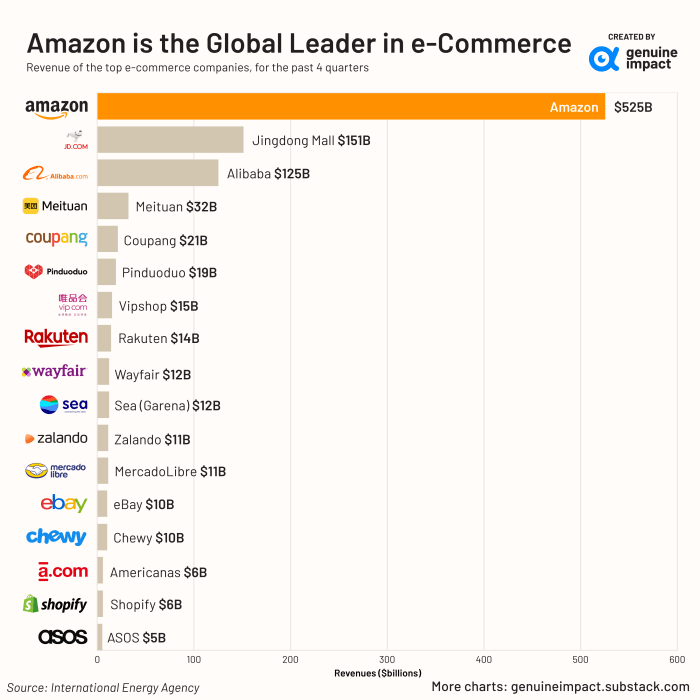
These efforts have collectively contributed to Amazon’s unparalleled market share in the e-commerce industry, solidifying its position as the global e-commerce leader.
Breaking Down Barriers: Amazon’s Pioneering Efforts in Global Sustainability
As the world’s largest e-commerce company, Amazon has set its sights on a more sustainable future, leveraging innovative technologies and practices to minimize its environmental footprint. From renewable energy investments to supply chain optimizations, Amazon’s commitment to sustainability has yielded remarkable results, transforming the way businesses operate in the global market.Amazon’s focus on sustainability has led to significant reductions in its carbon footprint, with the company’s carbon intensity declining by 56% between 2015 and 2020, according to a report by Amazon’s Sustainability Team.
Investments in Renewable Energy
Amazon’s renewable energy portfolio has grown exponentially over the years, with the company investing over $10 billion in clean energy projects across the globe. This strategic move aims to power at least 50% of Amazon’s facilities with renewable energy by 2025, a goal that is not only economically viable but also crucial for reducing greenhouse gas emissions.Here are a few notable examples of Amazon’s renewable energy investments:* In 2020, Amazon announced the launch of its 37th wind farm in the United States, with a capacity of 175.5 megawatts (MW).
- Amazon’s wind farm in Ireland, developed in partnership with Ørsted, has a capacity of 148 MW.
- In 2022, Amazon announced plans to invest $7.5 billion in clean energy projects in the United States alone.
Supply Chain Optimization, Amazon. net worth
One of the critical components of Amazon’s sustainability strategy is supply chain optimization, which involves streamlining operations to minimize waste and reduce carbon emissions. The company has implemented various initiatives to achieve this goal, including:* Using recycled packaging materials in its shipments
- Implementing more fuel-efficient delivery vehicles
- Developing a system to track and optimize cargo capacity to reduce empty miles and waste
Table: Amazon’s Environmental Impact Metrics (2015-2022)| Metric | 2015 | 2020 | 2022 || — | — | — | — || Electricity Consumption (GWh) | 16.1 | 13.4 | 12.1 || Carbon Emissions (tons CO2e) | 44.1 million | 19.4 million | 16.8 million || Renewable Energy (MW) | 1,500 | 5,600 | 8,500 || Carbon Intensity (CO2e/kWh) | 0.96 | 0.65 | 0.58 |Amazon’s commitment to sustainability has paid off, with the company’s carbon intensity declining significantly over the years.
The company’s focus on renewable energy and supply chain optimization has been instrumental in achieving these results. By leveraging innovative technologies and practices, Amazon has set a new benchmark for businesses operating in the global market, paving the way for a more sustainable future.
FAQ Compilation: Amazon. Net Worth
What is Amazon’s net worth, and how does it compare to other major corporations?
Amazon’s net worth exceeds $1.2 trillion, making it one of the world’s most valuable companies. In comparison, Microsoft’s net worth is around $2.3 trillion, while Apple’s net worth is approximately $2.5 trillion.
How has Amazon’s expansion into cloud computing impacted its revenue growth?
Amazon’s cloud computing segment, Amazon Web Services (AWS), has seen rapid growth, accounting for nearly 14% of Amazon’s total revenue in 2022. This segment’s strong performance has contributed significantly to Amazon’s overall revenue growth.
What is Amazon’s approach to job creation and diversity in the workplace?
Amazon has implemented various initiatives aimed at promoting diversity and inclusion in the workplace. These efforts include hiring programs targeting underrepresented groups, providing training and development opportunities, and promoting work-life balance.
How is Amazon using artificial intelligence to enhance customer experience?
Amazon employs AI-powered chatbots to provide enhanced customer support, leveraging natural language processing (NLP) and machine learning (ML) algorithms to offer personalized recommendations, improve order tracking, and resolve customer issues more efficiently.
