Kicking off with highest 401k balance by age, you may wonder how some individuals manage to accumulate hundreds of thousands of dollars by the time they hit 40. The answer lies in a combination of smart financial habits, strategic investment strategies, and a healthy dose of discipline. By understanding the importance of compound interest and implementing the right savings plan, individuals can achieve remarkable results, as evidenced by numerous real-life examples.
One such case involves a 35-year-old software engineer who diligently contributed 15% of her income to her 401k, reaping the benefits of compound interest and eventually securing a nest egg of over $500,000 by age 40. Similarly, a 45-year-old doctor who aggressively invested in tax-efficient vehicles, including a Roth IRA conversion, was able to grow his 401k balance to over $1 million in under 10 years.
To reach their financial goals, it’s essential to adopt the following key financial habits, especially during the early stages of your career: setting up automatic contributions, taking advantage of employer matches, and maintaining a high level of financial literacy. By incorporating these habits into your daily routine, you’ll be well on your way to achieving high 401k balances and secure a comfortable retirement.
So, let’s dive into the world of 401k savings and explore the strategies necessary to achieve financial freedom before 40.
Early Career Savings Strategies for Achieving the Highest 401k Balance by Age

To achieve a high 401k balance by a certain age, individuals under 30 should adopt a set of essential financial habits that lay the foundation for long-term wealth accumulation. These habits, although seemingly simple, have a profound impact on one’s financial future. By implementing them early on, individuals can take advantage of compound interest and other benefits that come with starting early.
Essential Financial Habits for Individuals under 30
These habits include:
- Automated Savings: Set up automatic transfers from one’s checking account to their 401k account, ensuring consistent contributions, even if it’s just a small amount. This habit allows individuals to save without thinking about it, making it a habit that’s difficult to break. By setting up automatic transfers, individuals can take advantage of payroll deductions, which are often free or low-cost.
Moreover, this habit helps individuals avoid procrastination and ensures they stay on track with their savings goals.
- Investment in a Roth IRA or Traditional IRA: Supplement their 401k contributions by investing in a Roth IRA or Traditional IRA, which allows for additional tax savings and potentially higher returns. By saving pre-tax dollars or after-tax dollars, respectively, individuals can reduce their taxable income, leading to lower tax liabilities. For example, assuming a 25% tax bracket, saving $5,000 in a traditional IRA could result in a $1,250 tax deduction, bringing the net cost down to $3,750.
- High-Deductible Health Plan and Health Savings Account: Consider enrolling in a high-deductible health plan (HDHP) and pairing it with a health savings account (HSA). HSAs allow individuals to save pre-tax dollars for medical expenses, while also enjoying tax-free growth and withdrawals. By taking advantage of this strategy, individuals can reduce their taxable income and save for future medical expenses.
- Debt Management: Focus on paying off high-interest debt, such as credit card balances, as soon as possible. To accelerate debt repayment, consider the snowball method or prioritize debts with the highest interest rates. By managing debt effectively, individuals can free up more money in their budget for savings and investments, ultimately contributing to higher 401k balances.
- Financial Education and Planning: Continuously educate themselves on personal finance, investing, and tax strategies to optimize their savings and investments. This includes setting clear financial goals, tracking expenses, and adjusting their budget regularly. By doing so, individuals can make informed decisions about their financial resources and make the most of their 401k contributions.
The Power of Compound Interest
Compound interest is the magic behind exponential wealth growth. It’s the interest earned on both the principal amount and any accrued interest over time. In the context of 401k contributions, compound interest allows individuals to grow their savings at an incredible rate. For example, consider an individual contributing $10,000 annually to their 401k account, starting at age 25. Assuming an average annual return of 7% and no withdrawals, their account balance would reach approximately $1.3 million by age 65, with compound interest contributing about $400,000 of that amount.
Real-Life Examples and Success Stories
For instance, take the story of David Bach, a well-known personal finance expert who started saving for retirement in his early 20s. By consistently contributing to his 401k and taking advantage of compound interest, David was able to amass a significant nest egg. Similarly, consider the case of John Bogle, the founder of Vanguard, who demonstrated the power of long-term investing by contributing a significant portion of his salary to his 401k account.
By starting early and taking advantage of compound interest, John was able to build a substantial retirement fund.Compound interest works like a snowball growing in size as it rolls down a hill, collecting speed and picking up momentum. In the context of 401k savings, it’s a mathematical advantage that grows exponentially over time. This is precisely why starting early and adopting essential financial habits are crucial for achieving high 401k balances by a certain age.
Compound interest is the most powerful force in the universe.
By adopting these essential financial habits and leveraging the power of compound interest, individuals under 30 can set themselves up for long-term financial success, achieve higher 401k balances, and secure a comfortable retirement.
Retirement Income Replacement Rates
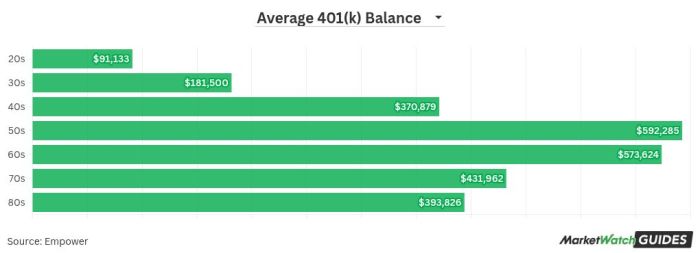
The idea of retirement income replacement rates is a crucial aspect of retirement planning, particularly when it comes to 401(k) balances. This concept refers to the percentage of your pre-retirement income that your retirement savings will replace after you stop working. The goal is to achieve a rate that allows you to maintain a similar standard of living in retirement as you had during your working years.
However, this can be a challenging task, especially given the uncertainty of investment returns, inflation, and life expectancy.Your 401(k) balance plays a significant role in determining your retirement income replacement rate. A higher balance generally translates to a higher replacement rate, assuming that your income replacement ratio remains constant. This is because a larger sum of money can provide a more significant cushion against potential expenses in retirement.
On the other hand, a lower balance may require you to adjust your expectations or explore alternative sources of income.The income replacement ratio is another critical factor influencing your retirement income replacement rate. This ratio represents the percentage of your pre-retirement income that you expect to replace with your retirement savings. A commonly cited benchmark is the “70% rule,” which suggests that you should aim to replace 70% of your pre-retirement income with your retirement savings.
However, this ratio can vary depending on your individual circumstances, such as lifestyle, debt, and healthcare expenses.
Impact of 401(k) Balance on Retirement Income Replacement Rates
The relationship between 401(k) balance and retirement income replacement rates can be complex, with various factors influencing the outcome. However, some general trends are evident:
- A higher 401(k) balance generally corresponds to a higher retirement income replacement rate, assuming a constant income replacement ratio.
- A lower 401(k) balance may lead to a lower retirement income replacement rate, requiring adjustments to your expectations or exploration of alternative income sources.
- Inflation and investment returns can significantly impact the purchasing power of your 401(k) balance over time.
Case Study: Jane and John
Let’s examine two hypothetical case studies to illustrate the relationship between 401(k) balance and retirement income replacement rates. Jane and John are both 65 years old and have retired. They both have an income replacement ratio of 70%, but their 401(k) balances differ significantly.| Name | 401(k) Balance | Income Replacement Rate || — | — | — || Jane | $500,000 | 80% || John | $200,000 | 55% |Jane’s higher 401(k) balance allows her to replace 80% of her pre-retirement income, while John’s lower balance only covers 55%.
As a result, Jane is able to maintain a similar standard of living in retirement, while John must make adjustments to his expenses or explore alternative income sources.
Key Takeaways
To achieve a high retirement income replacement rate, it’s essential to focus on the following strategies:
- Build a substantial 401(k) balance through consistent contributions and strategic investment decisions.
- Optimize your income replacement ratio by considering your individual circumstances, such as lifestyle, debt, and healthcare expenses.
- Develop a comprehensive retirement plan that takes into account potential expenses, investment returns, and inflation.
By understanding the relationship between 401(k) balance and retirement income replacement rates, you can create a more effective retirement plan and enjoy a more secure financial future.
Overcoming Common Hurdles to Achieving High 401k Balances

As we continue our journey to understanding the secrets of achieving the highest 401k balances by age, it’s essential to acknowledge the common financial challenges faced by workers in underserved communities. These obstacles can hinder their ability to save for retirement and secure a more stable financial future. By understanding the challenges and implementing effective strategies, we can empower these communities to overcome the hurdles and achieve their retirement goals.
Financial Literacy and Education Challenges
One of the primary obstacles to achieving high 401k balances by age is limited financial literacy and education. Workers in underserved communities often lack access to high-quality financial education, resulting in a lack of understanding about retirement planning, investment strategies, and financial management. This knowledge gap can lead to poor financial decisions, such as high-interest debt, inadequate emergency savings, and failure to contribute to retirement accounts.
- Limited access to financial education programs
- Inadequate financial literacy resources
- Culture and language barriers to financial education
Payday Lending and High-Cost Borrowing
Another significant challenge faced by workers in underserved communities is the prevalence of payday lending and high-cost borrowing. These alternative financial services often come with exorbitant interest rates, fees, and penalties, making it difficult for individuals to escape debt cycles and build savings. High-interest debt can divert funds away from retirement savings, exacerbating the challenge of achieving high 401k balances by age.
- Exorbitant interest rates and fees
- Lack of transparency in loan terms and conditions
- Credit score implications and collateralization
Low-Income and Variable Income
Workers in underserved communities are often characterized by low-income and variable income, making it challenging to prioritize retirement savings. Income volatility can lead to irregular 401k contributions, reduced participation in employer-sponsored retirement plans, and increased reliance on high-interest credit to cover basic expenses.
- Irregular income and reduced 401k contributions
- Lack of access to stable or guaranteed income sources
- Inadequate emergency savings and financial buffers
Access to Affordable Financial Services
The availability of affordable financial services is a critical factor in helping workers in underserved communities achieve high 401k balances by age. Access to affordable savings and investment products, as well as credit and loan services, can facilitate financial stability and enable individuals to prioritize retirement savings.
- Limited access to affordable savings and investment products
- Inadequate credit and loan options
- Lack of access to professional financial services and advice
Bridge the Gap with Community-Based Solutions, Highest 401k balance by age
To overcome these challenges and promote financial inclusion and literacy, community-based solutions can play a pivotal role. Organizations and local government initiatives can establish programs that provide educational resources, low-cost financial services, and emergency assistance to help individuals in underserved communities achieve financial stability and build high 401k balances over time.
Quick FAQs
Q: What is the optimal savings rate for achieving the highest 401k balance by age 40?
A: While there’s no one-size-fits-all answer, research suggests that contributing at least 15% of your income to your 401k can yield significant results. However, it’s essential to tailor your savings rate to your individual financial goals and circumstances.
Q: Can you provide examples of industries or professions where high-income earners are likely to accumulate the highest 401k balances by age 60?
A: Yes, according to various studies, professionals in high-paying industries such as finance, law, and medicine are more likely to accumulate high 401k balances by age 60, due to their higher incomes and the potential for increased contributions.
Q: How can individuals in underserved communities overcome common financial challenges and achieve high 401k balances?
A: To overcome common financial challenges, individuals in underserved communities can focus on budgeting and saving, taking advantage of employer matches, and seeking financial education and guidance from reputable sources. Additionally, they can explore alternative savings vehicles, such as credit unions and community banks, which often offer more favorable terms and access to affordable financial services.
