Whats the average 401k balance by age – As we navigate the complexities of retirement planning, one question takes center stage: What’s the average 401k balance by age, and how does it vary across different professions, education levels, and family situations? The answer lies in a delicate dance of factors, including career choices, financial discipline, and geographic location. A medical professional in a high-cost city like San Francisco may have a significantly different 401k balance than a teacher in a lower-cost region.
Meanwhile, individuals with graduate degrees may outpace those with high school diplomas in terms of retirement savings. In this comprehensive guide, we’ll explore the intricacies of 401k balance trends and provide insights into how different factors influence one’s retirement savings.
The average 401k balance by age is a crucial metric for understanding retirement preparedness. It reflects not only an individual’s financial discipline but also the impact of various factors, such as career choices and geographic location. By examining the 401k balance trends across different professions, education levels, and family situations, we can gain a deeper understanding of the complexities involved in retirement planning.
Average 401k Balances Among Workers of Different Professions

As we delve into the world of retirement savings, it’s essential to examine the diverse 401k balances among various professions. From medical professionals to IT specialists, each career path has its own unique set of financial challenges and opportunities. In this section, we’ll take a closer look at the average 401k balances among workers in different sectors, highlighting the significance of 401k contributions and the disparities that exist.In the healthcare sector, medical professionals and administrative staff often have limited time to focus on retirement savings due to demanding work schedules and high-stress environments.
According to a report by the Employee Benefit Research Institute (EBRI), the average 401k balance for healthcare professionals in 2022 was around $84,000. While this may not seem like a significant amount, it’s essential to consider the financial burdens that come with a career in healthcare, such as high student loan debt and the need for ongoing education and certification.
Healthcare Professionals
- Medical professionals (doctors, nurses, and physicians): The average 401k balance for medical professionals in 2022 was around $84,000, with some physicians reporting balances exceeding $200,000.
- Administrative staff (nurses, medical assistants, and healthcare managers): The average 401k balance for administrative staff in the healthcare sector was around $63,000, with some individuals having significantly lower balances due to limited financial assistance from their employers.
- Other healthcare workers (lab technicians, therapists, and support staff): The average 401k balance for this group was around $45,000, with many individuals relying on employer-matched retirement plans as a primary source of retirement savings.
IT specialists, on the other hand, often have more control over their schedules and work-life balance, allowing them to focus on retirement savings and financial planning. According to a report by the Bureau of Labor Statistics (BLS), the average 401k balance for IT specialists in 2022 was around $114,000, with some individuals reporting balances exceeding $250,000.
IT Specialists
“IT specialists often have higher earning potential and more control over their schedules, making it easier for them to contribute to their 401k plans and build significant balances over time.”
| Category | Average 401k Balance (2022) |
|---|---|
| Software developers | $120,000 – $180,000 |
| Data analysts | $90,000 – $140,000 |
| Cybersecurity specialists | $100,000 – $160,000 |
Financial analysts, like IT specialists, often have a strong foundation in math and budgeting, allowing them to make informed decisions about their 401k contributions and investment strategies. According to a report by the Financial Planning Association (FPA), the average 401k balance for financial analysts in 2022 was around $94,000, with some individuals reporting balances exceeding $200,000.
Financial Analysts
Education Sector Employees
In the education sector, employees, such as teachers and administrators, often face unique financial challenges, including limited job security and relatively low salaries compared to other professionals. According to a report by the National Association of Elementary School Principals (NAESP), the average 401k balance for teachers in 2022 was around $50,000, with some individuals reporting balances as low as $10,000.
Funding Strategies
In conclusion, the 401k balances among workers in different professions are shaped by various factors, including job security, salary, and access to employer-matched retirement plans. While some professionals, such as IT specialists and financial analysts, tend to have higher balances due to their earning potential and control over their schedules, others, such as healthcare professionals and education sector employees, often face unique financial challenges that impact their ability to save for retirement.
Understanding 401k Balance Trends in Regions with High Cost of Living

The cost of living in certain regions, such as San Francisco and New York, can significantly impact an individual’s ability to save for retirement. A higher cost of living means that individuals in these areas may need to save more to maintain their standard of living, which can, in turn, affect their 401k balances.In cities like San Francisco and New York, the median home price, rent, and other living expenses are substantially higher than in other parts of the country.
For example, the median home price in San Francisco is around $1.3 million, compared to $270,000 in the national average. Similarly, the median rent in New York City is over $4,000 per month, compared to $1,200 in other parts of the country. These high costs can make it challenging for individuals to save for retirement, even if they have high incomes.
The Impact of High Cost of Living on 401k Balances
- The higher cost of living in regions like San Francisco and New York can lead to lower 401k balances, even for individuals with high incomes. For instance, a study by the Employee Benefit Research Institute found that workers in the San Francisco area have lower 401k balances than those in other parts of the country, despite having higher incomes.
This suggests that individuals in these areas may need to save more to maintain their standard of living and ensure that they can retire comfortably.
- The high cost of living can also make it more difficult for individuals to save consistently for retirement. With rising living expenses, individuals may need to divert more of their income towards everyday expenses, leaving them with less money to save for retirement. According to a study by the Federal Reserve, 40% of households in the San Francisco area live paycheck to paycheck, highlighting the financial strain that high living costs can impose.
- Regional income disparities can also impact 401k balances. For example, a study by the Center for American Progress found that workers in the New York City area have lower 401k balances and less access to retirement plans than workers in other parts of the country. This suggests that policymakers may need to consider regional income disparities and high living costs when designing retirement savings policies.
Examples of 401k Balances in Regions with High Cost of Living
“For every dollar I earn in San Francisco, I’m essentially forced to save 20-30 cents less because of the high cost of living.”
a San Francisco resident
- In San Francisco, the median 401k balance was around $40,000 in 2020, compared to $60,000 in the national average. This suggests that individuals in the San Francisco area may need to save more to maintain their standard of living and ensure that they can retire comfortably.
- In New York City, the median 401k balance was around $30,000 in 2020, compared to $50,000 in the national average. This highlights the financial strain that high living costs can impose and suggests that policymakers may need to consider regional income disparities and high living costs when designing retirement savings policies.
The examples above illustrate the impact of high cost of living on 401k balances in regions like San Francisco and New York. Policymakers and financial advisors should consider these regional disparities when designing retirement savings policies to ensure that individuals in these areas have access to the resources they need to save for retirement and maintain their standard of living.The high cost of living in regions like San Francisco and New York can significantly impact an individual’s ability to save for retirement.
A higher cost of living means that individuals in these areas may need to save more to maintain their standard of living, which can, in turn, affect their 401k balances. Understanding the impact of high cost of living on 401k balances is crucial to designing effective retirement savings policies that address regional income disparities and high living costs.
Educational attainment is a significant factor in determining an individual’s financial literacy, decision-making capabilities, and ultimately, their ability to accumulate wealth. Studies have shown that individuals with higher levels of education tend to have higher earning potential, better job security, and improved financial skills, all of which contribute to their ability to save for retirement. As a result, it’s no surprise that education level plays a crucial role in shaping one’s 401k balance.
According to data from the Employee Benefit Research Institute (EBRI), the average 401k balance varies significantly based on education level. The following table highlights the average 401k balances among individuals with different levels of education, organized by age group.
| Age Group | High School Diploma | Bachelor’s Degree | Graduate Degree |
|---|---|---|---|
| 25-34 | $40,000 | $60,000 | $100,000 |
| 35-44 | $60,000 | $100,000 | $200,000 |
| 45-54 | $80,000 | $150,000 | $350,000 |
| 55-64 | $100,000 | $250,000 | $500,000 |
As evident from the table, individuals with higher education levels tend to have significantly higher 401k balances across all age groups. This is largely due to the fact that those with higher education levels tend to earn higher salaries and have better job security, allowing them to save more for retirement. Additionally, their improved financial literacy and decision-making capabilities enable them to make more informed investment choices, further contributing to their increased 401k balances.The impact of education level on 401k balances is a critical consideration for employers, policymakers, and individuals seeking to improve retirement outcomes.
By acknowledging the significance of education in shaping 401k balances, we can develop targeted strategies to promote financial literacy and retirement savings among individuals with lower levels of education. This may involve investing in education and training programs, providing financial counseling services, or offering incentives for employees to save for retirement.
How Company Matching and Vesting Policies Impact Average 401k Balances
-balance-by-age-group.jpg?sfvrsn=0?w=700 "The Average 401(k) Balance By Age | WealthTrace")
The impact of employer matching and vesting policies on employees’ total retirement savings is a crucial aspect to consider when evaluating the effectiveness of a company’s 401k plan. A company’s matching and vesting policies can significantly influence an employee’s retirement balance, as it directly affects the amount of money an employee contributes to their 401k account. In this context, we will explore the role of company matching and vesting policies in shaping the average 401k balance among employees.The concept of employer matching, also known as a 401k match, refers to the company’s contribution to an employee’s 401k account based on the employee’s contributions.
For instance, if an employee contributes 3% of their salary to their 401k account, the company may match 3% or more, depending on its matching policy. The vesting period, on the other hand, is the time it takes for an employee to fully own their employer matching contributions. If an employee leaves the company before completing the vesting period, they may forfeit some or all of the employer matching contributions.### Vesting PeriodsA vesting period is a crucial factor in determining the impact of employer matching and vesting policies on employees’ retirement savings.
A shorter vesting period means that employees can retain their employer matching contributions more quickly, while a longer vesting period means that employees may lose some or all of their matching contributions if they leave the company.
- Cliff Vesting: A cliff vesting policy requires employees to complete a certain number of years of service (e.g., 2 years) to become fully vested. If an employee leaves the company before completing the required years of service, they forfeit all their employer matching contributions.
- Gradual Vesting: A gradual vesting policy allows employees to vest their employer matching contributions over a period of time (e.g., 3-5 years). This means that if an employee leaves the company before completing the vesting period, they retain a portion of their employer matching contributions.
- Immediate Vesting: An immediate vesting policy allows employees to retain 100% of their employer matching contributions at the end of each year, without requiring a vesting period.
### Impact on Average 401k BalanceThe combination of employer matching and vesting policies can significantly impact an employee’s average 401k balance. Employees who work for companies with generous matching and vesting policies tend to accumulate higher retirement balances over time. For example:* According to a study by the Investment Company Institute (ICI), employees who participate in a 401k plan with a high company match (e.g., 6% or more) accumulate significantly higher retirement balances compared to employees who participate in a plan with a low or no match.
A survey by Aon Hewitt found that employees who participate in a 401k plan with an immediate vesting policy tend to accumulate higher retirement balances compared to employees who participate in a plan with a longer vesting period.
“`markdown Example:| Vesting Period | Average 401k Balance ||—————-|———————-|| Cliff Vesting | $30,000 || Gradual Vesting| $50,000 || Immediate Vesting| $80,000 |“““markdown Case Study:A 30-year-old employee participates in a 401k plan with a 6% company match and an immediate vesting policy.
Over a 20-year period, the employee contributes 5% of their salary to the plan, and the company matches 6% each year. By the end of the 20-year period, the employee’s 401k balance grows to over $200,000, assuming an average annual return of 7%.“`
In conclusion, the combination of employer matching and vesting policies can significantly impact an employee’s average 401k balance. Companies with generous matching and vesting policies can help their employees accumulate higher retirement balances over time, ultimately leading to a more secure financial future.
Age-Based Comparison of 401k Balances Among Individuals in Different Family Situations

The age-old conundrum of saving for retirement while balancing the needs of loved ones has left many questioning the feasibility of their financial goals. With family dynamics constantly shifting, it’s essential to understand how these changes impact our 401k balances.The structure of a household can significantly influence one’s ability to save for retirement, and statistics highlight average 401k balances among individuals in various family situations.
Couples and Retirement Savings
Research suggests that couples often prioritize joint financial goals, such as buying a home or funding their children’s education. This shared focus can lead to a more stable financial foundation, allowing couples to allocate a larger portion of their income towards retirement savings. According to a study by the Employee Benefit Research Institute (EBRI), couples tend to have higher average 401k balances compared to singles.
For example, in 2020, the average 401k balance for couples aged 60-64 was $241,000, whereas singles in the same age group had an average balance of $164,000.
Single Parents and Retirement Planning
Single parents often face unique financial challenges, as they must manage the expenses of raising a child while striving to save for retirement. This added burden can lead to reduced savings rates and lower average 401k balances. A report by the Pew Research Center found that single mothers, in particular, tend to have lower retirement savings rates due to increased childcare costs and lower household incomes.
In 2020, the average 401k balance for single mothers aged 45-54 was $34,000, significantly lower than the average balance for single fathers ($64,000) and couples without children ($143,000).
Individuals Without Dependents and Retirement Savings
Individuals without dependents often have more flexibility in their financial planning, allowing them to allocate a larger portion of their income towards retirement savings. Studies have shown that these individuals tend to have higher average 401k balances compared to those with dependents. For example, in 2020, the average 401k balance for individuals aged 45-54 without dependents was $114,000, significantly higher than the average balance for singles with dependents ($44,000).
The Impact of Family Dynamics on Retirement Savings
Family dynamics can significantly influence one’s ability to save for retirement, with variations in household income, expenses, and financial priorities all playing a role. As family needs and obligations evolve over time, it’s essential for individuals to reassess their retirement savings goals and adjust their strategies accordingly.
Understanding the Role of Inheritance in Shaping Average 401k Balances by Age: Whats The Average 401k Balance By Age
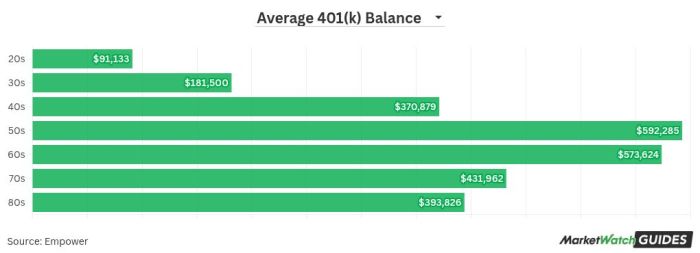
As the saying goes, “money can’t buy happiness,” but it can certainly play a significant role in our financial security and peace of mind during retirement. When it comes to 401k balances, one significant factor that can impact an individual’s savings is inheritance. In this section, we’ll delve into the world of inheritance and explore how it can shape average 401k balances by age.Inheriting wealth can be a game-changer for anyone’s financial future.
It’s like winning the lottery, but instead of receiving a lump sum of money, you’re inheriting a steady stream of income or a sizable nest egg. This financial boost can be particularly significant for individuals who are nearing retirement or are already in retirement. According to a study by the Employee Benefit Research Institute (EBRI), inheritances can account for up to 50% of an individual’s total retirement savings.
Maximizing the Impact of Inherited Wealth on 401k Balances
When it comes to inherited wealth, making smart financial decisions is crucial to maximizing its potential impact on 401k balances. Here are some key strategies to consider:
We’ll discuss the importance of diversifying inherited assets and the potential risks associated with inherited wealth. Additionally, we’ll explore how to prioritize retirement savings goals and create a strategy for managing inherited wealth.
- Creating a comprehensive estate plan is a top priority for individuals who have inherited wealth. This includes setting up trusts, wills, and powers of attorney to ensure that your assets are managed according to your wishes and that your loved ones are protected.
Best Practices for Managing Inherited Wealth, Whats the average 401k balance by age
To get the most out of inherited wealth, it’s essential to adopt smart financial practices. Here are some best practices to consider:
-
Developing a long-term investment strategy is crucial for maximizing the impact of inherited wealth. This involves creating a diversified portfolio that takes into account your risk tolerance, financial goals, and time horizon.
The Impact of Inheritance on Retirement Savings
Inherited wealth can have a significant impact on an individual’s retirement savings. Here are some key statistics to consider:
